Show the process.
Explain a strategy, demonstrate it and let the learner practise it with feedback. Break complex instructions into manageable steps.
IELTS & DYSLEXIA
Individual IELTS preparation for students with dyslexia. Work with a teacher to find useful strategies, build your English and prepare with a clearer plan.
FOUR SKILLS · INDIVIDUAL SUPPORT
Dyslexia does not tell us everything about how you learn. We start with the tasks you find demanding, the strategies you already use and your IELTS goal. These are examples of support we can explore together.
Explore a skill to see how preparation could change
A dense passage can make it hard to track information while moving between text and questions.
We can work with one paragraph at a time, model how to locate evidence and compare the question with the passage’s wording.
Match “a fall in demand” with “fewer people wanted it”, then explain the connection.
Planning, organising ideas and checking spelling at the same time can make writing feel crowded.
We can rehearse a response aloud, build a short outline and review one aspect at a time before combining the steps.
First check whether each paragraph supports your answer. Then make a separate pass for recurring language errors.
Following the recording while reading questions and writing answers can be demanding.
In lessons, we can preview question types, practise predicting the kind of answer needed and revisit short sections with a transcript.
Identify whether a gap needs a date, a number or a place before listening. Replaying is a learning tool, not an exam arrangement.
Finding a word or organising a longer answer under time pressure may be an individual concern.
We can try a simple planning frame, rehearse with changing prompts and use specific teacher feedback to develop your answer.
For a longer turn, make brief notes for the setting, the event and why it mattered, rather than memorising a script.
We gradually move towards realistic exam practice. Learning supports used in lessons are separate from arrangements approved for your IELTS test.
RESEARCH INTO PRACTICE
Research helps us ask better questions about teaching. Your experience helps us decide which adjustments are useful for you.
Explain a strategy, demonstrate it and let the learner practise it with feedback. Break complex instructions into manageable steps.
Return to language and strategies in different contexts, with purposeful review rather than a stream of unrelated tasks.
Try a reading guide or a clearer task layout, then review what helps. Reduce guidance as the learner becomes ready to work more independently.
These principles draw on Judit Kormos’s Specific Learning Difficulties in ELT (Cambridge, 2020), especially its guidance on inclusive materials, explicit instruction and reading strategies (pp. 12–16).
The paper also highlights gaps in research with second-language learners and older age groups. It informs teaching choices; it does not establish that a particular C2 tool will improve an IELTS score. Font, spacing and colour options are personal preferences to explore, not a treatment for dyslexia.
For background, see the British Dyslexia Association’s explanation of dyslexia. Official test arrangements are covered separately below.
OFFICIAL IELTS ACCESS ARRANGEMENTS
Here is something worth knowing before you book: IELTS offers access arrangements for candidates with specific learning difficulties, including dyslexia. The standard stays the same. The conditions may be adapted to help you demonstrate your English fairly.
Additional time for Reading or Writing, and modified Listening recordings with extra pauses, may be approved.
Enlarged print papers and permission to use familiar transparent coloured overlays are among the options.
Supervised breaks, approved computer use for writing, or support with answer sheets may be possible. Spellcheck and grammar tools are not permitted.
Contact your chosen test centre before booking. Some arrangements take six weeks to organise; ask the centre about its deadline and the supporting report it requires.
GOOD TO KNOW
IELTS applies the same marking standards to every candidate. C2 can help you understand the guidance and prepare, but only the test provider can approve access arrangements.
Our teaching tools support learning during preparation. In the official IELTS test, only arrangements approved by the test provider are permitted. C2 does not diagnose dyslexia or guarantee an IELTS band.
THE C2 APPROACH · PERSONALISED IELTS PREPARATION
Your IELTS preparation is guided by a real C2 teacher through individual lessons, personal feedback and a plan built around your needs. Interactive tools help you practise between lessons, with support you can adjust.
You're learning with a teacher, not signing up to a self-study platform.
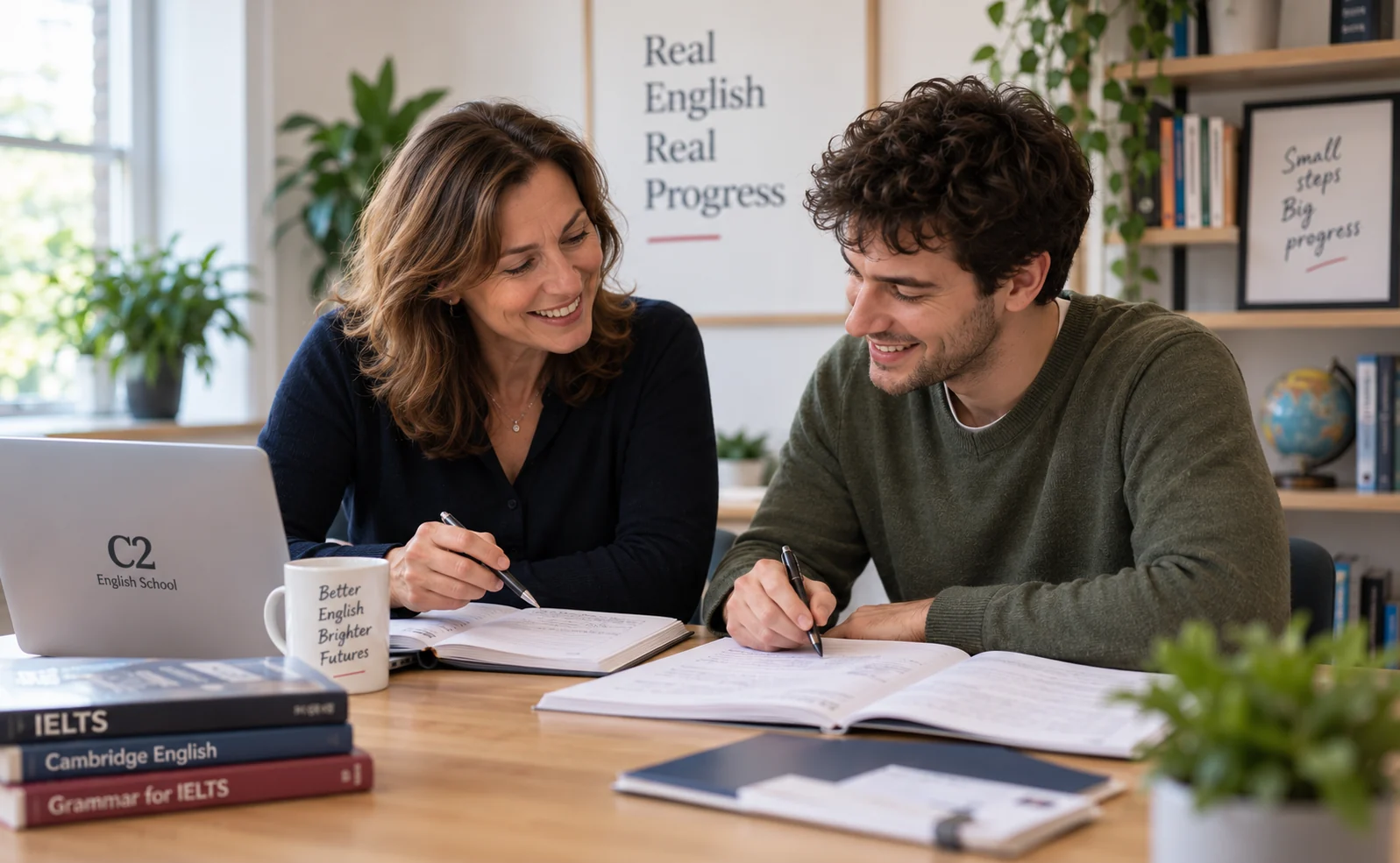
Talk things through. Ask questions. Receive feedback from a teacher who understands your goals.
Successful learning does not always feel easy. Sometimes, taking time to find evidence helps an idea become clearer.
Try the modes above. This illustrates adjustable support; it is not the full application.
Adjust reading settings, explore paraphrases and practise finding evidence between lessons.
A structured approach. Adapted to you.
We explore your English level, IELTS goals, learning preferences and previous experiences together.
HUMAN EXPERTISEBuild language and exam strategies with your teacher. Reinforce them through purposeful practice.
HUMAN + TECHNOLOGYUse adaptable scaffolding: guidance can be increased or reduced as your needs change.
ADAPTABLE SUPPORTApply strategies under realistic conditions, including approved access arrangements where relevant.
TEACHER-GUIDED READINESSReal teachers, adaptable learning tools and a preparation journey built around you.
Let's plan your IELTS preparation →BETWEEN YOUR LESSONS
Real teachers guide your individual IELTS preparation. Between lessons, C2 IELTS Focus keeps you practising with interactive tools, adaptable scaffolding and reading tasks that ask you to identify supporting evidence.
READING PASSAGE 1 · EVIDENCE LAB
When learning feels effortless, people often assume that it is working well. Yet research into memory suggests that some forms of difficulty can strengthen learning, provided the challenge is manageable.
One example is retrieval practice. Attempting to recall information without looking is harder than rereading, but it can make memories more durable.
The principle has limits. Difficulty is not automatically beneficial: a task that overwhelms a learner can consume attention without producing useful learning.
Interactive preview · The full application is a private beta for authorised C2 accounts. Not an official IELTS test.
YOUR QUESTIONS
Practical answers about preparation, extra time and the difference between learning support and exam arrangements.
Yes. IELTS offers access arrangements for candidates with specific learning difficulties, including dyslexia. Your chosen test centre will explain the application and evidence requirements. The marking standards remain the same.
Extra time may be approved based on your needs and supporting evidence. IELTS describes 25% extra time as a usual request; this is not an automatic entitlement. Contact your test centre early and check the current official guidance linked above.
Possible starting points include working paragraph by paragraph, identifying key words and paraphrases, and locating the evidence for each answer. Your teacher can model the process and adjust practice to your needs. We then work towards the conditions of your actual test.
No. IELTS uses the same marking standards. Spelling and grammar errors can still affect marks where these are assessed. Approved access arrangements change how you access the test, rather than the level of English required.
The reading ruler, highlighting and adjustable support shown here are preparation tools. They are not permission to use those tools in an official test. Only arrangements confirmed by your test provider apply on test day.
Start with a conversation about your English, target band, exam date and previous learning experience. We can discuss a suitable starting activity and possible teaching support. Our standard online diagnostic is timed and is not adapted for dyslexia, so please contact us first.
Access-arrangements guidance checked 31 October 2026. Confirm current requirements with your chosen test centre.
YOUR NEXT STEP
Every IELTS journey is different. Tell us about your target band, your learning experience and what you'd like help with.
We'll arrange a conversation to understand your needs and explore how individual preparation with C2 could work for you.
Our standard IELTS Academic diagnostic test is timed and is not adapted for dyslexia. Contact us first so we can discuss a suitable starting point for you.
Let's talk about your IELTS goals ← Back to IELTS PreparationA real conversation. No automated course recommendation.
C2 ENGLISH SCHOOL UPDATES
Loading signup…